
At BMA we do our best to measurably reduce the ecological footprint in sugar production. Our plants and processes are designed to use energy efficiently, reduce emissions, and utilise raw materials in an optimal way. The technologies applied by modern falling-film evaporators (FFE) and powerful extraction plants demonstrate how economic efficiency and sustainability can be successfully combined in sugar production.
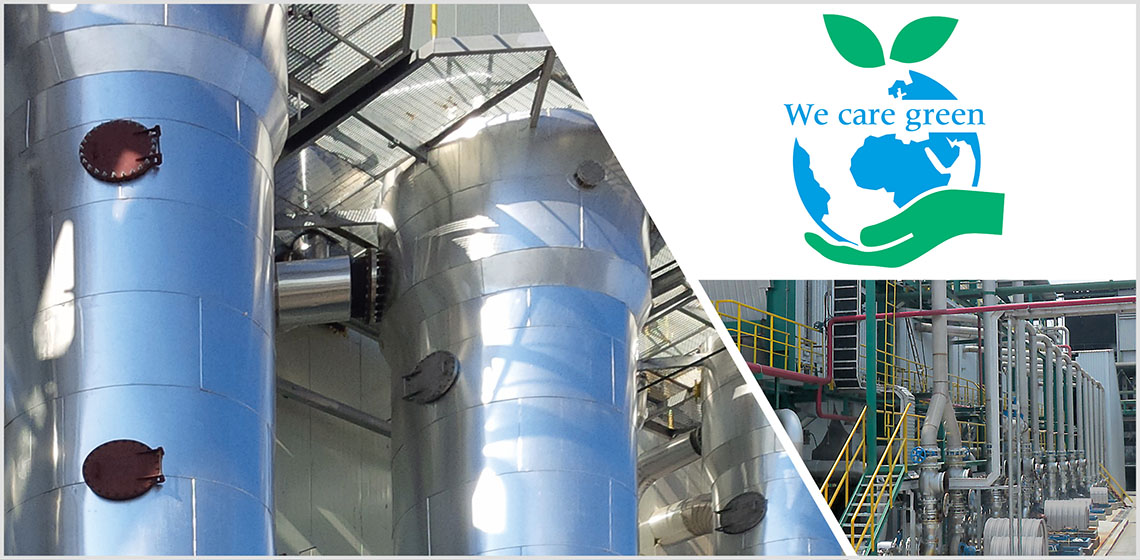
Every tonne of steam counts – for increased efficiency and less emissions
BMA falling-film evaporators and extraction plants help realise a clear reduction in the power demand for sugar production
“We care green” – making energy efficiency measurable
Under the label “We care green”, BMA expresses the aspiration to develop technologies that contribute measurably to decarbonisation and a higher energy efficiency. What counts is what can be proved – by data showing a reduced energy consumption, less CO₂ emissions, and improved efficiency factors.
BMA falling-film evaporators in practice
One example is the multi-stage evaporation of sugar raw juice: In a plant with a daily processing capacity of 10,000 tonnes of cane, a six-stage system of BMA tube-bundle falling-film evaporators allows for a very low steam consumption – bringing along a clear increase in energy efficiency.
30 percent less energy thanks to smart evaporation
Compared to conventional plants, the energy input into the evaporation process can be reduced by about 30 percent. This helps improve not only the climate footprint, but also economic efficiency. Every tonne of steam that can be saved will reduce the demand for bagasse, the standard fuel in the sugar industry. In this way, more steam will be available for climate-friendly power generation.
Efficiency benefits also for sugar juice extraction
BMA contributes to the reduction in energy consumption also in other sugar production steps – for example, in the extraction of sugar juice. Here, more and more factories are working with diffusers from BMA: continuously working systems with a reduced power consumption and simultaneously higher sugar yields.
Diffusers setting new standards in extraction
For a sugar factory crushing 10,000 tonnes of cane per day, the average power consumption for the diffusion process is around 1.8 MWh. In contrast, a conventional milling train with five mills – which has been the standard in the sugar industry for a long time – would consume about 4.5 MWh.
Investments that will pay off
Therefore, investments in modern diffusers and falling-film evaporators will pay off: Thanks to the high energy savings, the initial costs can be recouped mostly within a short time.